Support my team and I to make more videos like this at: https://patreon.com/tomnicholasCapitalism is dead. Killed by its own biggest fans. That's the thesis ...
No, a single store can never be a market by definition. Varoufakis actually spends some time in the interview trying to explain that.
Of course if your definition of unrestrained capitalism is entirely devoid of markets and competition than you can argue like you do, but that is really bending the definition even in Marxist terms, no need to go lala-land of libertarians for that.
But if you include those, than Varoufakis is right and what we see these days isn’t really capitalism any more, but something else more akin to feudal rent extraction.
No, a single store can never be a market by definition
I’m not referring to a single store. I’m referring to the laws that prevent a single company from owning ALL stores. That Amazon has gotten away with what would have been Anti Trust if a grocery store chain tried to consolidate doesn’t make Amazon different from capitalism.
Company towns were a thing during the heyday of Capitalism.
Renaming pure Capitalism into Techno feudalism is whitewashing Capitalism.
Oh, that’s not Capitalism. That’s Cronism. Oh that bad thing isn’t Capitalism, it’s techno feudalism.
Ok, so maybe you understand it better if I explain it like that: if a single company would own absolutly everything would that still be capitalism? At least by Marxist and pretty much all other relevant economic theories, no.
And that is not whitewashing anything. That’s just using correct definitions. No one said anything about classical capitalism being good.
if a single company would own absolutly everything would that still be capitalism?
But Amazon doesn’t own everything. There is Google, Meta, Apple and Microsoft. Deregulated capitalism is still capitalism. Company towns were closer to Techno Feudalism that Amazon but Marx called Company Towns Capitalism, not Techno Feudalism.
Obviously it isn’t as clear cut as that hypothetical argument. But we have an oligopol of these companies, each having their own fiefdom and competing very little with each other. And within their fiefdoms there is no such thing as a market, because they control everything.
Company Towns are really of little relevance to the argument as they only applied to the employees of a company and not their customers or how companies compete with each other.
But we have an oligopol of these companies, each having their own fiefdom and competing very little with each other.
Just like Standard Oil and Carnegie Steel.
That’s classic Capitalism.
Company Towns are really of little relevance to the argument
Company towns are relevant in that it represented a total ownership of the workers by the corporation which is far closer to the term “feudalism” than Apple selling smartphones and charging businesses rent to sell on their platform.
There is a substancial difference because Standard Oil and Carnegie Steel were just large single companies. They never controlled the market access for other companies like Amazon etc. practically do.
Company towns at most affected a few thousand workers each. Sure, for those workers being stuck in them it was pretty much feudalism, but this has little to do with the overall economic system. At no point in time a majority of the population lived in company towns, unlike the situation we have now where the digital fiefdoms pretty much cover the lives of everyone.
Anyways, I recommend you just read Varoufakis’ book, which does a much more thourogh analysis than what I can do here. Of course even Varoufakis says that you can argue this is just another permutation of capitalism, but the fact remains that it is a substantially different economic model. Just summarizing it as “capitalism bad” and failing to analyze why this is actually different and thus needs different methods to fight against is interlectually lazy.
There is a substancial difference because Standard Oil and Carnegie Steel were just large single companies. They never controlled the market access for other companies like Amazon etc. practically do.
Total control of energy and materials is worse than not getting access to a popular store front. You can sell your products on your own website. But if you didn’t have materials and energy you can’t produce your own goods.
failing to analyze why this is actually different and thus needs different methods to fight against
My claim, based on Marx, is that it isn’t different and can be controlled in exactly the same way corporations have always been controlled.
Monopolies should be broken up. It doesn’t require any reframing. The only reason for calling capitalism “techno feudalism” is because being anti capitalism is a political third rail. But by saying “I’m pro capitalist but against techno feudalism” it makes it palatable to the public.

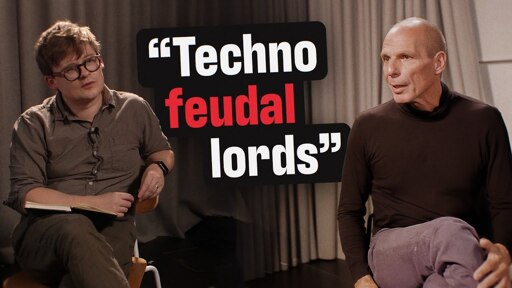
No, a single store can never be a market by definition. Varoufakis actually spends some time in the interview trying to explain that.
Of course if your definition of unrestrained capitalism is entirely devoid of markets and competition than you can argue like you do, but that is really bending the definition even in Marxist terms, no need to go lala-land of libertarians for that.
But if you include those, than Varoufakis is right and what we see these days isn’t really capitalism any more, but something else more akin to feudal rent extraction.
I’m not referring to a single store. I’m referring to the laws that prevent a single company from owning ALL stores. That Amazon has gotten away with what would have been Anti Trust if a grocery store chain tried to consolidate doesn’t make Amazon different from capitalism.
Company towns were a thing during the heyday of Capitalism.
Renaming pure Capitalism into Techno feudalism is whitewashing Capitalism.
Oh, that’s not Capitalism. That’s Cronism. Oh that bad thing isn’t Capitalism, it’s techno feudalism.
Ok, so maybe you understand it better if I explain it like that: if a single company would own absolutly everything would that still be capitalism? At least by Marxist and pretty much all other relevant economic theories, no.
And that is not whitewashing anything. That’s just using correct definitions. No one said anything about classical capitalism being good.
But Amazon doesn’t own everything. There is Google, Meta, Apple and Microsoft. Deregulated capitalism is still capitalism. Company towns were closer to Techno Feudalism that Amazon but Marx called Company Towns Capitalism, not Techno Feudalism.
Obviously it isn’t as clear cut as that hypothetical argument. But we have an oligopol of these companies, each having their own fiefdom and competing very little with each other. And within their fiefdoms there is no such thing as a market, because they control everything.
Company Towns are really of little relevance to the argument as they only applied to the employees of a company and not their customers or how companies compete with each other.
Just like Standard Oil and Carnegie Steel.
That’s classic Capitalism.
Company towns are relevant in that it represented a total ownership of the workers by the corporation which is far closer to the term “feudalism” than Apple selling smartphones and charging businesses rent to sell on their platform.
There is a substancial difference because Standard Oil and Carnegie Steel were just large single companies. They never controlled the market access for other companies like Amazon etc. practically do.
Company towns at most affected a few thousand workers each. Sure, for those workers being stuck in them it was pretty much feudalism, but this has little to do with the overall economic system. At no point in time a majority of the population lived in company towns, unlike the situation we have now where the digital fiefdoms pretty much cover the lives of everyone.
Anyways, I recommend you just read Varoufakis’ book, which does a much more thourogh analysis than what I can do here. Of course even Varoufakis says that you can argue this is just another permutation of capitalism, but the fact remains that it is a substantially different economic model. Just summarizing it as “capitalism bad” and failing to analyze why this is actually different and thus needs different methods to fight against is interlectually lazy.
Total control of energy and materials is worse than not getting access to a popular store front. You can sell your products on your own website. But if you didn’t have materials and energy you can’t produce your own goods.
My claim, based on Marx, is that it isn’t different and can be controlled in exactly the same way corporations have always been controlled.
Monopolies should be broken up. It doesn’t require any reframing. The only reason for calling capitalism “techno feudalism” is because being anti capitalism is a political third rail. But by saying “I’m pro capitalist but against techno feudalism” it makes it palatable to the public.