
Physicalism or materialism. The idea that everything there is arises from physical matter. If true would mean there is no God or Free Will, no immortal soul either.
Seems to be what most of academia bases their world view on and the frame work in which most Science is done.
Often challenged by Dualism and Idealism but only by a loud fringe minority.
I’ve heard pan-psychicism is proving quite the challenge, but I hear that from people who believe crystals can cure autism
I hear that “Oh actually the science is moving away from materialism” as well, but that seems to be more crystal talk as well.
So lemme ask science instead of google.
Any reason to doubt physicalism? Is there anything in science that says “Huh well that seems to not have any basis in the physical at all and yet it exists”
Edit: I have heard of the Essentia Foundation and Bernado Kastrup but since it’s endorsed by Deepak Chopra I’m not sure I can trust it
that seems to not have any basis in the physical at all and yet it exists
If it has no basis in physical reality, how would you detect, measure or quantify it? On what basis would you prove its existence?
Tune your consciousness into the vibrations. Duh.
I mean, if spontaneously every person on Earth heard a voice in their head say “I’m God and I love all of you, be nice to each other” in their own languages, but no physical evidence of the event could be found, that could count.
Possibly. Let’s revisit the issue if that ever comes to pass.
Except that’s a pretty material event. If thing A interacts with thing B there is a material thing happening between them, which can immediately be measured and quantified.
It wouldn’t help that such an event happens only once, but you’ll still have 8 billion data points to draw a conclusion from.
Assuming that the universe actually exists outside ourselves and that our perceptions can be explained by some set of rules (that we call “physics”) seem like necessary axioms to get anywhere in science. You could reject those assumptions, but then I don’t see much of a compelling reason to accept anything beyond solipsism if you don’t believe in reality.
That said, I’m not sure that physics will ever be able to provide a good, complete explanation of qualia.
Of course it can. We are biological machines. Not every machine is perfect copy of another. Differences in the organs that perceive the world will lead to subjective experiences. There’s no “mystery”.
Does an LLM have subjective experience? The characters in The Sims – or the game itself? A thermostat? An ant colony, collectively – separate from its individual ants? The entire country of, say, Honduras, collectively? A corporation? A database? Bacteria? A human skin cell? A tumor, independent of its host? A traffic jam? Grains of sand in an hour glass? A tree? A flea? A dog?
Why is my perception of the color red the way that it is? You can swap the red and blue components of an image around and things are just as recognizable, but the experience of it is noticeably different… Why does red look like red instead of red and blue being the other way around in my subjective experience? Is your experience of red the same as mine, or are red and blue swapped for you relative to my perception of them? We know from people with color blindness that not everyone experiences the color red the same way, but how can you probe whether the perception of the color wheel is rotated by, say, 90 degrees in hue between two people with otherwise compatible perception of color?
Why don’t I experience heat on my skin the same way that I experience vision? Or touch, for that matter? People with synesthesia can have radically different subjective experience; perhaps we’ll uncover some answers from probing that – since people can talk to us – but how can we ever probe the similarities and differences in the experience that bats and dolphins may have of echolocation? If bats and dolphins could talk to each other, would their differences in the experience of echolocation be like red-green color blindness, or like vision and touch?
There probably are answers to all those questions, but given that subjective experience can only be experienced by the subject, how would you test for it? Even if there are answers, I’m not sure if it’s possible for us to know them from our point of view in the universe.
I never understood the point of “qualia” and “p-zombies”. To act exactly as a human does, you need the internal voice that is among your motivating factors to act like you do.
Not sure what you are talking about. Science isn’t philosophy or religion, you can’t make choices what’s true or isn’t. A fact is a fact.
Right, so is it a fact that nothing can exist outside of the physical world?
No it isn’t, because you can’t prove that something doesn’t exist. However, everything which has been shown to exist (is detectable by scientific experimentation) is part of the physical world.
If you are talking about things which aren’t detectable, then science wouldn’t be concerned with those things because they aren’t worth thinking aboutThis is kind of wrong, and is a common conflation with respect to science. First, scientists do talk about things that cant be proven, string theory being just one of them. It’s an idea of the physical world that cant be proven. If we have a way to actually test a hypothesis of string theory, it will get more attention. But if you don’t have people thinking about these things, we won’t have better models for describing the universe, such as relativity. Similarly, science can’t prove a negative. Science will never tell you God doesn’t exist or can’t exist, only that we have no proof that God exists and that we have no model where he could. But our knowledge has been less complete before, and our models have been updated as knowledge is gained.
And much of philosophy has no basis in the physical world, but this doesn’t mean it isn’t worth thinking about.
Ok so firstly, no theory can be proven. You’re thinking of theorems. One of the tests of a scientific theory is its falsifiability. A simple example would be that if a single apple floats upwards from the tree instead of falling to earth, that would falsify the theory of gravity. In string theory, the falsifiability lies in the predictions of quantum mechanics. A falsification of QM would collapse string theory immediately. Of course, you’ve chosen this particular theory because it is at the fringes of current understanding and there is debate over whether it’s a legitimate theory. However, it is actually founded on rigorous study, and its predictions are exactly as consequential as its falsifiability is agreed upon.
While it cannot be proven using current methodologies, that problem puts it in such distinguished company as general relativity and even Galilean relativity were in terms of the experimental technology available to natural philosophers at the times of conception. String theory can be proved, or disproved, just not yet. So we don’t write it off as academic, but we file it under “pending”, until such a time as we are able to test it. This is absolutely the astute thing to do.
If you have a test for God, please propose it. It seems that this particular question is beyond both practical and philosophical technology at this point in human history. There is no theory about God that can be tested, falsified, repeated and scrutinised as far as I know, so why would science waste time on this question? Maybe in the future we will have a knife of some kind that can carve meaning into this question, but we don’t at the moment. There’s a separate discipline for pondering abstract questions which we can’t test, it’s called philosophy. And it pushes science, when the time is right, to find evidence. But until philosophers find a way to test their suppositions, their suppositions are not worth thinking about,for a scientist.That’s precisely why I chose string theory, because it does have value, even if it can’t be tested at this time. Yet, even though little can be done to advance it, shrugging and ignoring it won’t change that state, if you’re a scientist.
As for the pondering of philosophers, there is a good chance that many of their questions will never be answered, and yes, there would be little value to study them, as a scientist. But that qualifier has a dramatic effect on your previous statements.
Any reason to doubt physicalism?
Describe “doubt” in purely physical terms.
Any reason to believe there’s anything at all outside of the physical universe or exists but is not tied to anything physical. Anything at all.
Like what?
I don’t know that’s why I’m asking
Then I don’t know either, and I don’t think either of us can know. Because if it’s knowable, it’s measurable, and physical. If it’s not knowable, not measurable, then you can’t show that it exists.
“Has anyone found a viable alternative to falsifiable hypotheses?”
So the thing is, like other commenters have said, you’re asking metaphysics things through the prism of science, which does not work because by nature, science uses the (mostly) objective scientific method, while metaphysics is based on subjective assessments.
You have to separate the physical, material universe as being in the domain of what can be known, from the rest, which can not be, and never will. This does not mean it doesn’t exist, just that it can never be studied or proved in any way, so anyone can believe what they wish about it without leaving rationality (as long as the belief does not imply things concerning the material universe)
We do not have enough evidence to conclude that subjective experience will never be objectively measurable, sufficiently advanced neuroscience absolutely could reach a point where every aspect of human experience could be measured observed and compared. We almost certainly won’t live to see it though.
I think the framing of questions like this assumes that there are certain “physical” things that follow one intrinsic set of laws, and certain other things that follow a fundamentally different, incommensurate set of laws.
But we don’t actually have direct knowledge of any intrinsic laws, physical or otherwise—the best we have are a set of purely provisional laws we’ve made up and regularly revise on the basis of cumulative evidence. And our method for revising these provisional laws requires that any new evidence that contradicts a law, invalidates it—provisional laws must apply to everything without exception. If we give ourselves the out that contradictory evidence can be explained by “non-physical” causes, we can never invalidate anything nor revise our understanding. So dualistic models are inherently unscientific—not because they’re wrong, but because starting with such assumptions is incompatible with the scientific method.
this seems more like metaphysics, or philosophy than actual science, this would be more appropiate in that discussion. you odnt want to mix religion into science.
It would be science, because I’m asking if something that isn’t physical in origin exists.
It sounds like you’re trying to use the wrong tool, though. Science is a great system for learning about the observable universe, but less so for other things. To put it another way, science is great for telling you how, philosophy is great for exploring why.
But aren’t most philosophers Physicalists who just say “Listen to the science”
Science isn’t actually “physicalist”. In fact one major theory in science, Quantum Mechanics, would probably challenge physicalism since quantum suggests that there will always be unknowable physical quantities regarding any given particle of matter. It also suggests that particles of matter (and light) must interact with an observer in order to exist in a state where some physical quantities can be known; else these particles exist only in an exotic state of indefinite probalistic fluctuations.
I must say though, even though quantum challenges physicalism, quantum’s model of the universe truly rejects the possibility of any omniscient entity. Omniscience requires the ability to know everything about the universe and quantum suggests that this is in fact impossible; therefore a truly omniscient god would be impossible. It was for this reason that god-fearing Albert Einstein rejected quantum mechanics up until his death bed.
I think this makes a lot of sense:
It also depends how you define physical matter.
If it’s something you cam touch, then there definitely is, starting with neutrinos.
If you mean particles we know about, can describe and sort of understand, then there’s dark matter, which is probably particles we don’t know yet, but have several candidates we didn’t manage to confirm or disprove yet. They can only interact by gravitational (and perhaps weak?) force.
If you mean something we know at least something solid about, there’s dark energy, which isn’t absolutely 100% certain that it exists, but is widely accepted.
If you mean something physics doesn’t detect and try to explain, then obviously not.
How is Dark Matter non-physical?
In the sense that it isn’t particles we know about, can describe and sort of understand, as I wrote. Plus you can’t touch it. You didn’t say what you mean by physical, so I tried 4 different definitions I thought you might mean.
Any reason to doubt physicalism? Is there anything in science that says “Huh well that seems to not have any basis in the physical at all and yet it exists”
If it had no basis in the physical, then what would it mean to say that it “exists?” How you define “existence” is a very big philosophical question. Excuse me while I nerd the fuck out about something.
Physics tells us that the observable universe is 93 billion light years in diameter. However, we can sometimes observe objects leaving the observable universe. This is because of complicated physics reasons:
Physical space is expanding with time. Everything is getting farther apart from everything else, and the more distance there is between two points, the faster the space in between them is expanding. At a sufficiently large distance, the rate at which the distance between the two points is increasing, is faster than the speed of light. Neither point is actually moving faster than the speed of light, it’s only the space between them that is expanding. This might be hard to understand, but think of it as if you drew two dots on a balloon and then inflated it.
Once an object gets far enough away from us that the space between is expanding faster than the speed of light, it becomes impossible for us to make any further observations about that thing. This is actually what defines the bounds of “the observable universe.”
So, what happens to objects that leave the observable universe? Strictly speaking, it’s impossible to say. Intuitively, we would expect that they’re still there doing their thing and obeying the same physical laws as when we could observe them. But, if you told me that the stars simply vanish, or that they magically transform into butterflies as soon as they leave, there’s no evidence that anyone could ever produce that would falsify that belief, because, by definition, there is no way to observe what happens outside of the observable universe. If we are defining what exists based on what is physically observable, then it follows that things outside the observable universe do not exist, even if it really seems like they should.
My conclusion from this line of thought is that existence is a relational property. I am not prepared to reject the idea that a thing has to be in some way observable in order to exist, but in that case, nothing can exist in isolation. Because for a thing to be observable means that there must exist a being which could observe it. This could be said to contradict physicalism, because physicalism would say that the material world exists regardless of our senses. I would say that the physical world only exists so long as there are beings capable of sensing it, and, should all sentient beings ever become extinct, the physical world would no longer exist in any meaningful sense.
I think the main problem with this sort of logic is that it presumes that what we see is reality. This isn’t necessarily true.
Evolution has shaped us to see that which is most important for our survival. If seeing things as they truly are would interfere with our evolutionary fitness, then our brains would filther that out. In fact, this seems very likely, evidence being the many illusions that can be used to fool our senses.
If this was the case, then physical objects may not exsist at all, they would just be an artifact of this filtering effect. Roland Hoffmann is a great resource for understanding this sort of theory.
I think the main problem with this sort of logic is that it presumes that what we see is reality. This isn’t necessarily true
What could possibly be considered more “real” than that which we can observe and experience?
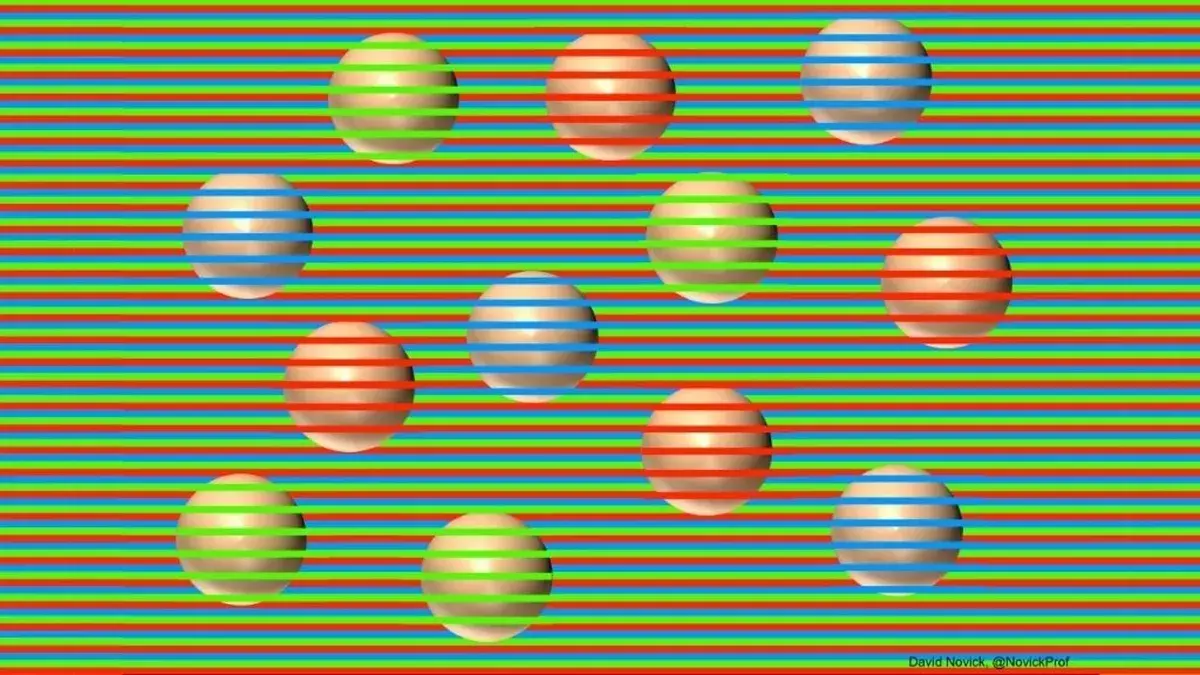
How about the spheres in this image? Which colors do you observe? And which colors are they really?
I’m not trying to be condescending, it’s just an example of how our senses do not necessarily display reality.
I think people are completely misunderstanding me. I am fully aware that optical illusions exist, I don’t see how that has any relevance to what I’m actually saying.
How do you know what colors they really are? You know by making more detailed observations than you might at first glance, for example, by zooming in. What exactly is that meant to demonstrate?
If a whole bunch of different people are all misunderstanding you in the same way at the same time then the obvious explanation is that you’re failing to communicate clearly
I encourage you to go to a honky tonk and try to explain Marxism to people and see if you still feel that way afterwards.
Refer to anything that I actually said and show how you could logically draw the conclusions you made about my positions from that.
I could absolutely explain Marxism to people at a honky tonk, wouldn’t be any harder than explaining Marxism to people in any other location. Already did that once, keep up
I don’t think either of us is getting anything out of this conversation. Let’s just leave it, ok?
Not sure what the point of this was then.
Finally, something we agree on.
We observe solid matter to not be composed mostly of empty space, that observation is verifiably incorrect. Our senses evolved to help us survive in our natural environment, being able to perceive empty space between/within atoms would do fuck all to help us survive seeing as how we can’t meaningfully interact with that empty space on our own. We invented devices to compensate for the limits of our senses and discovered that reality often differs drastically from our experience. To answer your question, it’s what we can prove.
Of course, our observations can show that other observations are incorrect. But that’s still relying on senses and observation. That doesn’t change the fact that reality consists of that which can be observed.
No, there are actually a lot of things we can measure and study that are unobservable with our senses, and a shitload of verifiable ways in which our senses either misinterpret reality or completely fail to perceive it
No, there are actually a lot of things we can measure and study that are unobservable with our senses
The way we measure things is by making them observable to our senses. I can’t see radiation, but I can read a Geiger counter. Radiation is, therefore, capable of being observed.
and a shitload of verifiable ways in which our senses either misinterpret reality or completely fail to perceive it
Again, everyone seems to be reading this as, “Actually, senses are perfect and incapable of being fooled.” Which I never said anything remotely similar to. No shit they can be fooled. This has zero relevance to the discussion.
Let me explain this again.
-
Stars that leave the observable universe, by definition, cannot be observed. There is no way to verify or falsify any claims that are made about them.
-
Physicalism states that matter continues to exist regardless of our ability to make observations about it.
-
Therefore, physicalism claims that stars that leave the universe continue to exist, even though there is no way to verify or falsify this claim.
-
Therefore, either physicalism is wrong, or verificationism, the idea that our claims need to be supported by evidence and be falsifiable, must be false.
I resolve this contradiction by sacrificing physicalism and saying that matter must be observable. That does not mean observable by the naked eye, or that our senses are somehow infallible, both of which are strawmen that have nothing whatsoever to anything I’ve said.
This argument is more of a philosophical argument than a scientific one. It reminds me of the classic “if a tree falls in the woods and no one is there to hear it, then does it make a sound?”. The purpose of this statement is to question whether the observer is a requirement for something to be real.
Ultimately, I think science doesn’t have a solid answer to this question. Quantum mechanics might suggest the answer to be “no”, since matter exists as a probability function until something measures (observes) it. This would suggest that a lack of observer would leave matter in an exotic state which would not allow such a definite process as falling in the woods. On the other hand, general relativity would suggest that the tree would make a sound because all matter affects the spacetime continuum whether an observer is there or not. This would suggest that the tree’s existence is independent from an observer. The tree’s matter will bend spacetime and will still be subjected to the effects of existing within a curved spacetime geometry. Therefore, the tree would exist and fall resulting in a sound.
Of course, the big issue in science right now is that we have failed to disprove both quantum mechanics and general relativity; but these two primary theories of science are incompatible with eachother. Ultimately, this means that this question regarding physicalism is presently unanswerable by science.
A Geiger counter doesn’t make radiation physically observable, it just gives you information about it, your senses are still 100% incapable of detecting it. You chose the exact words “What could possibly be considered more real than that which we can observe and experience?” and I responded by accurately pointing out that our senses are imperfect and our experiences frequently fail to accurately represent reality. You should leave the explaining to people who are better at it.
-
“Has anyone found a viable alternative to unfalsifiable hypotheses?”
Umm, I thought there was the concept of antimatter. No?
No reason to doubt it.
I think it is possible, logically at least, to have gods, free will and souls even if everything were physical matter, unless you define those terms specifically to be metaphysical but then its like a True Scotsman fallacy.
Physicalism might be the most viable, but that does not mean its viable enough. There are huge holes - we have no explanation for consciousness, sentience, free will, physics still doesn’t explain everything physical, and quantum mechanics is such a weird aberration of physical matter I am tempted to not call it that.
However, nothing beats the scientific method for truth finding at the moment. And, at the moment, the scientific method is content with only giving us physical results.