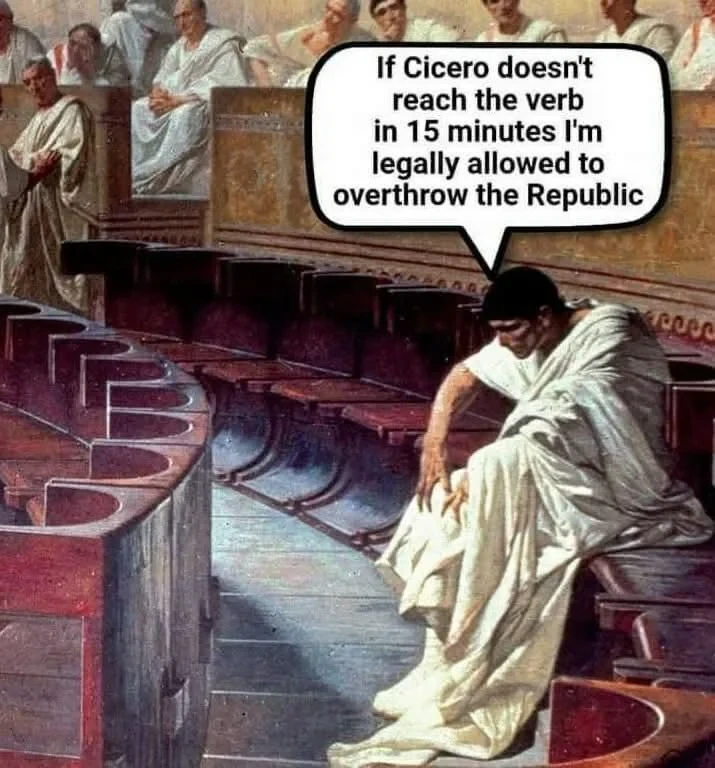

Explanation: The image is from a famous (if not entirely accurate) 19th century painting depicting the Roman conspirator Catiline (pictured) being harangued by the politician and famed orator Cicero.
Catiline was accused (almost certainly correctly) of attempting to overthrow the Roman Republic… but Cicero’s oratory is infamous amongst Latin students for taking forever to place the verb and stop filling up space with nested statements. DRAMATIC EFFECT
If Cicero doesn’t reach the damn verb in the next 15 minutes, Catiline’s coup is perfectly legal!
It’s the only way Roman law could stop Cicero from going on indefinitely. 😔
So it’s not only us Germans who delay the verb that much. Just be glad you don’t work as an interpreter for Ancient Latin
Korean comes to mind as an SOV language.
There are many SOV languages, including Japanese and Turkish. In fact, SOV is the most common word order, followed by SVO and after a gap VSO.
The thing about German is that it can be both but the word order isn’t free either, as it is in Latin, but there are rules that aren’t straightforward at first glance. So short sentences often have SVO with a 1:1 translation to English but the more complicated the sentence, the more often you have SOV, especially when you count the content word and not the auxiliary. I can go into more detail how this so called “verb second” works if you want. But I think that that’s where the frustration comes from: easy sentences are intuitive and then – boom – out of the blue it changes.
Also: German is a Western European language so English native speakers are more likely to come into contact with it.
I’m a native German speaker. German is only strictly SOV in dependent clauses, in main clauses verb is is always in second position (V2) and if it’s more than one verb everything else is pushed to the end of the clause.
I’m also a native speaker and you said nothing that contradicts what I said. I even elaborated on the difference between auxiliary and content verbs. No one cares about the former.

Even with my terrible level in Latin, I’m glad to say I got that reference!