
link to open access paper https://www.nature.com/articles/s41598-026-68201-6

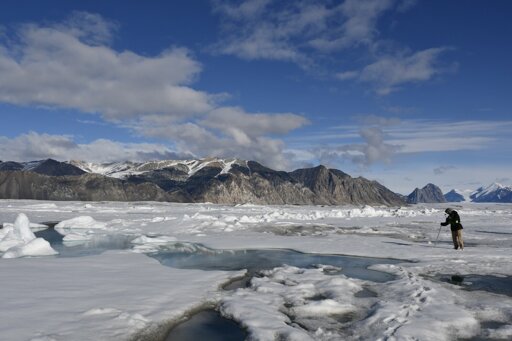
Figure 6. Connection between the Milne Fiord epishelf lake and the ocean. a) Photo of the basal channel before the calving event (July 2019; photo credit: Derek Mueller). b) Photo of the basal channel after the calving event (July 2023; CC BY, photo credit: Cameron Fitzpatrick). Schematics of cross-sections across the basal channel before © and after (d) the calving event. Schematics of cross-sections along the basal channel before (e) and after (f) the calving event. In panel e, the darker ice polygon is the ice shape along the basal channel and the lighter ice rectangle is the ice shape behind (thicker with more freeboard)
Oof… I didn’t know what an epishelf lake was, just in case anyone else doesn’t either
And the article goes on to say
Ugh. So beyond sad. I’d like to say that I hope this will be a wakeup call for folks, but if the multiple scientists’ warnings and all the other signs weren’t… sigh
We think the end of the world is something that arrives all at once, but it is a series of progressively louder collapses of the way of things around us until we realize it has already arrived here and only just now its bow wake has caught up to stir us into an awareness of its presence.
I wish we wrote obituaries for ecosystems, we sorely need them.
You’re so right.
I’ve been in the same location pretty much my whole life, I can easily call out weather/species changes just in my local area from when I was a kid til today… I miss all the animals and bugs! Heh.
It truly boggles my mind that some folks are able to turn the destruction of our planet (and our collective future) into a “belief” or an “opinion”…
I mean, I get not trusting the govt obviously, but the scientists who are sharing fact-based information and predictions? Especially when we can see so much with our own eyes, too?! Trying not to be too much of a doomer but…
An obituary is a good idea. Even if it doesn’t sway any opinions, it could help some of us to grieve. I might try my hand at that when I’m in the right headspace. Thanks. ❤️