• 3 Posts
  • 20 Comments
Joined 22 days ago
cake
Cake day: August 19th, 2026

help-circle
  • You want to fill those with some spray foam adhesive before you install them. Otherwise, they might blow off in a heavy wind.

    Oh, smart idea!

    (Also, this was already posted a couple of weeks ago.)

    Oops, I scrolled through recent posts to double check before posting, but I didn’t search the whole community. Just now, I was going to find/link the one you’re referencing but searching didn’t give me results for 3d, makerworld, flock sock, or the direct link. So especially if there’s good convo on that one, please link it if you can! And hopefully this one will help get more new eyes on it! :)


  • You’re so right.

    I’ve been in the same location pretty much my whole life, I can easily call out weather/species changes just in my local area from when I was a kid til today… I miss all the animals and bugs! Heh.

    It truly boggles my mind that some folks are able to turn the destruction of our planet (and our collective future) into a “belief” or an “opinion”…

    I mean, I get not trusting the govt obviously, but the scientists who are sharing fact-based information and predictions? Especially when we can see so much with our own eyes, too?! Trying not to be too much of a doomer but…
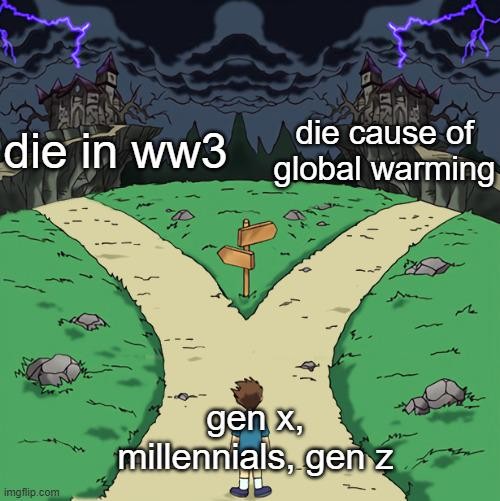
    A "two paths" meme where both paths are dark. The bottom text representing the character says "Gen X, Millenials, Gen Z" and the left path is "die in ww3" and the right path is "die cause of global warming"

    An obituary is a good idea. Even if it doesn’t sway any opinions, it could help some of us to grieve. I might try my hand at that when I’m in the right headspace. Thanks. ❤️




  • Oof… I didn’t know what an epishelf lake was, just in case anyone else doesn’t either

    Epishelf lakes form when an ice shelf acts as a dam, trapping a layer of freshwater floating above seawater connected to the ocean. The Milne Fiord epishelf lake, located on northern Ellesmere Island in Nunavut, supported freshwater microorganisms near the surface and marine species below.

    And the article goes on to say

    “Epishelf lakes can signal when an ice shelf is under stress, and that’s what we saw here,” said co-author Dr. Bernard Laval, a professor of civil engineering at UBC who leads its environmental fluid mechanics research group. “The data showed the ice shelf was failing. Once the ice is gone, the ecosystem goes with it. There’s no coming back.”

    “Epishelf lakes are remarkable because a freshwater ecosystem sits directly above a marine one, separated only by a thin boundary between fresh water and salt water,” said co-author Dr. Andrew Hamilton, a research scientist at the University of Alberta who completed his Ph.D. research at Milne Fiord. “When the ice shelf broke apart, that unique ecological structure disappeared.”

    “These systems took thousands of years to form and were lost in months,” said Bonneau. “On any human timescale, they are not coming back.”

    Ugh. So beyond sad. I’d like to say that I hope this will be a wakeup call for folks, but if the multiple scientists’ warnings and all the other signs weren’t… sigh


  • Ah okay, that makes sense. The parm we got was marked “aged over 10 months” and it did seem a bit less dry than some of the more aged ones we’ve used in the past. We did just use the smallest side on the box grater though, not a microplane, so it’s definitely possible that it needed to be more finely grated. And that’s a great tip about just doing it w the pasta water at first, then adding in the butter, that sounds like a safer way to do it. And I’ve heard folks talking about using the sodium citrate in cheese dishes before but I’ve never actually tried it… Thanks so much! :)


  • Yess! Our local convenience store honored it, too! It had to be the complete image, if it was partially cut off, it didn’t count! I didn’t know it was never the intent… I remember going through the bin trying to see which ones had a star visible without unwrapping them… Haha.

    And now this is reminding me of also trying to peer up through the 20oz soda bottles without opening them in hopes of being able to read the inside of the caps so I could get a free one. Heh.


  • Here’s the info from https://cribb.substack.com/p/how-to-become-earth-citizens

    We are now living amid the greatest emergency in humanity’s million-year tenure of the Earth.

    This is a compounding catastrophe created by our relentless exploitation of the planet’s finite resources, natural systems and resilience - and the terminal overpressure of our exploding numbers. Collapse, according to Bill Rees, may prove inevitable.

    Yet no government or global organisation has a systematic plan to address it – or any way to arrest the compounding damage.

    World science has been warning us for over half a century that we are hurtling towards disaster, driven by ten catastrophic risks. However, these risks, described below, are rarely discussed together or even seen as part of the same process.

    All ten threats are propelled by four main forces: overpopulation, overconsumption, overpollution and money.

    Because they are so deeply interlinked, they cannot be resolved one at a time – but must be solved together - and by integrated solutions that make none of them worse.

    1. Extinction

    Our civilisation is switching off the Earth’s life support system.

    Three quarters of large wild animals are already gone, in just a few decades. So are most birds, fish, reptiles and frogs.

    Humans and our livestock now make up 96% vertebrate life on land.

    We are transforming forests into deserts and oceans into dead zones.

    We are poisoning the biosphere, which threatens our own existence too.

    2. Resource scarcity

    Every year, in just seven months, human consumption surpasses what the Earth can renew.

    Together, we use 105 billion tonnes of materials annually - 12.8 tonnes each - destroying soils, water and wildlife along the way. Our resource consumption has quadrupled since 1970. It is projected to soar to 160 billion tonnes by 2050.

    Acute freshwater scarcity now affects over half the world’s people. Under humanity’s dominion, the forests are falling and the oceans are dying.

    3. Global Poisoning

    We are poisoning every living thing, every day. Especially our children, whom we fill with plastic microparticles and other toxins even before they are born.

    Human chemical emissions exceed 220 billion tonnes a year, five times larger than our climate emissions.

    They kill 14 million people annually (WHO). This is the largest mass homicide in history. Nobody cares.

    Neurotoxins are increasingly linked by science to a 13 point loss in human intelligence since 1975, guaranteeing a dumber race.

    4. WMD

    The world spends $2.7 trillion a year on new weapons.

    12,000 nuclear warheads menace all life on our planet. Even a small nuclear war could kill 2-3 billion people, mostly by starvation.

    The Doomsday Clock now sits at 89 seconds to midnight – the closest humans have ever come to absolute annihilation.

    5. Hothouse Earth

    Despite all the promises and good intentions, emissions of greenhouse gases continue to rise sharply. The world is on track for +2°C by 2050 and +3-4°C by 2100. Beyond that, scientists are warning, it could reach a point of no-return, becoming totally uninhabitable to large animals, including humans.

    So far, climate predictions have seriously underestimated actual temperature increases.

    Under such hostile conditions many food and water supplies will fail, causing nations and societies to collapse and refugees to flood worldwide.

    Methane from melting permafrost, the ocean floor and tropical wetlands is already venting. This means the Earth is now heating itself - and there is nothing humans can do to stop it.

    6. Food scarcity

    Our modern food system wastes over a billion tonnes of food a year. At the same time, it destroys the soils, water, ecology and the very climate it depends on. It is engineered for its own destruction.

    The stable climate on which our food supply depends is already extinct. The new one is hostile to farming. Water and soil to grow food are running out. Just feeding a single person for one day costs the Earth the loss of 8.2 kilos of topsoil. In 2024, 295 million people faced acute hunger.

    We must urgently replace our present system with renewable food that recycles all its nutrients and water, uses far fewer resources and is climate-proof.

    7. Uncontrolled technologies

    We are unleashing a swarm of dangerous new technologies — AI, global surveillance, robot killers, nanopollution, man-made viruses, geoengineering.

    These have no regulation, ethical or public oversight or means of control. Nor do the greedy billionaires who promote them and tout their benefits while ignoring their downsides.

    Like fossil fuels before them, these tools can each inflict vast global harm if misused or unregulated by society.

    8. Pandemics

    Since 2000, we’ve had nine pandemics. Several are still running. More are on the way.

    All pandemics are man-made: they mainly result from overpopulation, overcrowding, environmental destruction, global travel, misinformation and bad science.

    Rogue scientists continue to create deadly new viruses.

    WHO warns the next pandemic may be worse than COVID.

    9. Overpopulation

    The human population has tripled in a single person’s lifetime.

    Each year, we add 70 million more people to a planet already strained to breaking point.

    An animal is reckoned by science to be overpopulated when its demands begin to destroy the environment it inhabits and basic needs for its survival. Humans are now considered by many authorities to be well past that point, and thus overpopulated.

    Mass migration could run into the billions as climate, conflicts, resource and food scarcities and sea level rise displace entire regions.

    10. Misinformation

    To add to our confusion, lies have become a https://cribb.substack.com/p/the-black-work-of-big-oil.

    The fossil fuel sector pioneered paid disinformation. Politicians, media and other corporates have seized on it.

    Mis/disinformation now poisons public discourse, disables democracy, kills individuals and prevents society from taking actions urgently needed for our own safety.

    The Human Emergency

    All these megathreats are connected and must be solved together, not one at a time. That way lies only disaster. The Council for the Human Future describes this constellation of threats as ‘the human emergency’.

    Global action by a united humanity is not only necessary – but possible. The internet enables global discussion, rational decision and positive action. (As well as lies and nonsense).

    Beneficial solutions to the main threats already exist and some (such as abandoning fossil fuels) are well-known – but, as yet, there is no global plan to implement them.

    A plan

    If we want to survive, humans must first agree to survive. Without a strong global consensus on how to secure our future, there is no safe way forward.

    We must agree to tackle all ten catastrophic threats to our future, together - and as a matter of absolute urgency.

    That is why the Council for the Human Future considers we need an Earth System Treaty – a single, binding, legal agreement to act on ALL the threats that surround us.

    An umbrella agreement that any individual, as well as any group, company or nation can sign and pledge themselves to.

    This would be the first truly global act of democracy, open to all members of our species, an agreement to secure our children’s future.

    The Treaty

    An Earth System Treaty is an agreement among rational, concerned citizens to work together to prosper on a habitable planet.

    It seeks to safely abate each of the ten massive risks which confront us – and commits us to taking safe action to remedy them all.

    Especially, it binds us to lowering human numbers and moderating our consumption of resources by re-use.

    It commits us to living within the safe boundaries of the Earth, as defined by the Stockholm and Potsdam institutes and many others.

    Its aim is to ensure our grandchildren can survive on a habitable planet - instead of a ruined one.

    It is among the most important, inspiring and noble causes ever undertaken by humans.

    Earth Citizens

    The Council for the Human Future also considers that now is the time for a new kind of human to emerge – the Earth Citizen.

    An Earth Citizen is one who believes in preserving a green, habitable Earth, rich in plants, animals and other diverse species, for our grandchildren.

    Not the charred, desecrated cinder we are presently creating for them.

    An Earth Citizen supports positive action against all major threats to human survival and the Earth system that sustains life.

    An Earth Citizen has a personal commitment to do something positive, every day, to help build and secure a sustainable Earth in future.

    An Earth Citizen is loyal to our common humanity and the planet that gives us life, rather than the competing nations, religions, businesses and cultures that would destroy it.

    Let us all strive to become Earth Citizens – and uphold these simple values.

    Unless we first agree together to survive, we probably won’t.