

Apparently Lemmy turns my backslashes (used to escape round brackets inside a link) into forward slashes, leading to Lemmy users complaining:
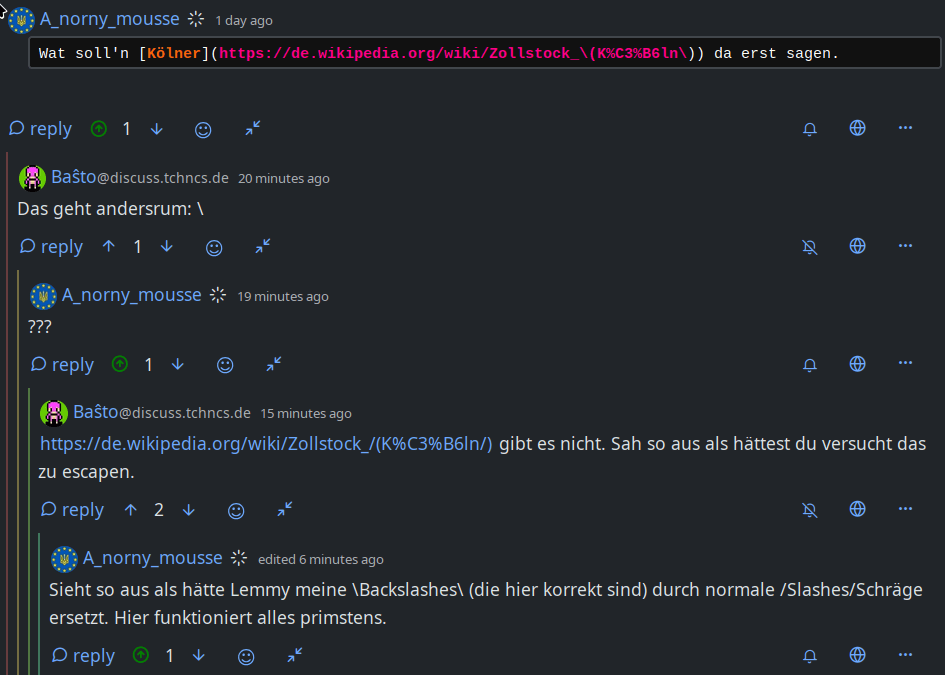
Lemmy does not require the round bracket to be escaped in this case. Why it turns backslashes into forward slashes I have no idea, but it does so even when I try the same thing straight from a Lemmy instance.
Is escaping things with backslashes not common practice in Markdown?
I know there’s so many implementations of Markdown it’s hard to even speak of a Spec, but backslashes serve this purpose almost universally. On computers that is.
I sense an overarching narrative of Lemmy vs Piefed developing here. Or maybe a need for communication between all client developers, on how to implement things so they work across the fediverse.
Hmm, it does feel more like a Lemmy problem in this case.
Where could I raise awareness on the Lemmy side, short of opening an issue on their git repos?
TESTING
Zollstock
It works without escaping! Why did I even get into the habit? Must’ve been a problem months if not years ago. FWIW, escaping with backslashes characters that might otherwise have MD-specific meaning is common, normal even.
Ignore it if you will, but converting them to forward slashes is just wrong.
Yes. Pretty sure this isn’t the first complaint about the Markdown parsing. We’ve had some changes in the past. And I’m not even sure if this is well-defined. Some of Markdown is a bit weird. If I remember correctly, I’ve used software before which just uses the first closing bracket and cuts off the link there. And another question: What happens if a URL contains a mismatched amount of brackets? like https://palaver.p3x.de/test)page I don’t think that’d workpage)
Edit: Yeah, that’s just wrong 😅
I assume
\gets changed to/because they are supposed to be equivalent as directory separators? You know, Windows stuff. Either way, in a URI, you should use URI encoding to escape characters, not markdown escapes. So that’d be%28, not\(.